
The Truth About Powder Coating vs. Traditional Patina Finishes
In architectural metalwork, the finish dictates the lifespan. Why we often argue against commercial powder coating in favor of deep-penetrating oil and chemical patinas.
The Great Debate in Architectural Metalwork
For decades, powder coating has dominated the metal finishing industry. Walk into any commercial fabrication shop, and you'll find rows of electrostatic spray booths, curing ovens, and technicians in respirators applying uniform coats of polyester or epoxy powders. It's efficient, consistent, and profitable. But is it truly the best choice for architectural metalwork that needs to stand the test of time?
As a master blacksmith with over 25 years of experience in Northern Michigan's demanding climate, I've developed a deep skepticism of powder coating for certain applications. Don't get me wrong—it has its place in mass production and industrial contexts. But when we're talking about custom railings, gates, furniture, and artistic installations that will be exposed to the elements for decades, I believe traditional patina finishes offer superior longevity, aesthetic depth, and repairability.
Understanding Powder Coating: The Good and the Bad
Powder coating works by electrostatically charging dry powder particles and spraying them onto a grounded metal surface. The coated piece then enters an oven where the powder melts, flows, and cures into a hard, continuous film. The result is a thick, durable finish that's resistant to chipping, scratching, and fading.
The advantages are clear: excellent color consistency, good corrosion resistance when properly applied, and the ability to create textured or smooth surfaces. For automotive parts, industrial equipment, and mass-produced consumer goods, it's an outstanding solution.
However, powder coating has significant limitations that become apparent in architectural applications. The primary issue is edge coverage—sharp corners and complex geometries often receive thinner coating, creating weak points where corrosion can begin. Once water penetrates beneath the coating through a chip, scratch, or edge failure, it spreads rapidly between the coating and the substrate, causing widespread bubbling and peeling that requires complete removal and reapplication.
The Art and Science of Traditional Patinas
Traditional patina finishes work on an entirely different principle. Rather than creating a barrier layer atop the metal, chemical patinas actually react with the surface, creating a conversion coating that becomes part of the metal itself. This is particularly true for copper-based metals like bronze and brass, where the patina is a protective layer of copper carbonate or copper sulfate that forms naturally over time.
For steel and iron, we use a variety of chemical treatments—phosphoric acid, ferric chloride, cupric sulfate—to induce controlled oxidation and coloration. These aren't just surface coatings; they're molecular changes that penetrate into the metal. When properly sealed with high-quality oil or wax finishes, these patinas create a finish that breathes with the metal, expands and contracts together, and can be refreshed indefinitely without complete removal.
Case Study: The Lake Leelanau Staircase
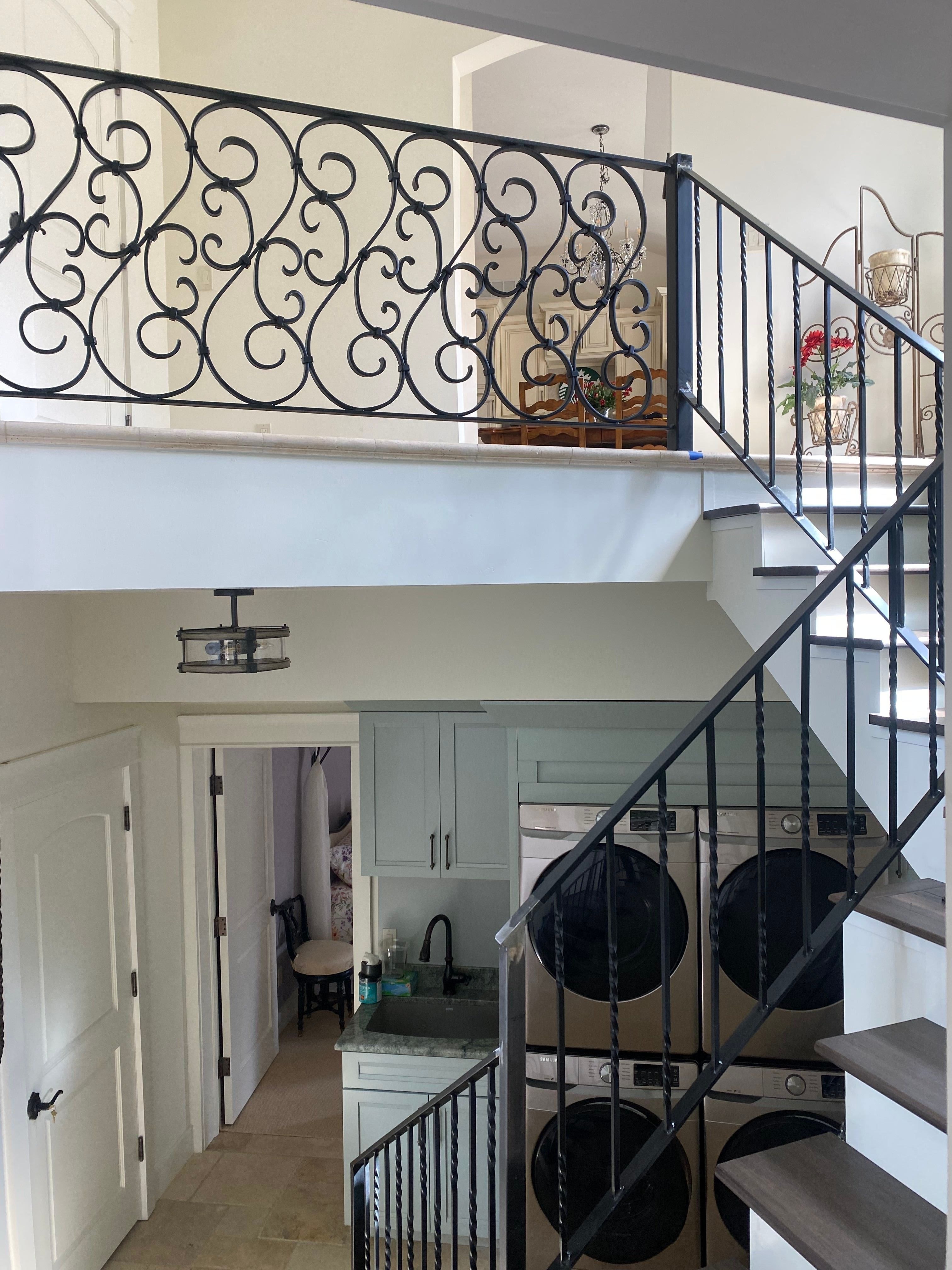
A perfect example of this philosophy in practice is the spiral staircase we completed for a Lake Leelanau waterfront home. The client initially requested powder-coated steel for the entire structure, citing concerns about maintenance. However, after discussing the environmental factors—direct lake exposure, high humidity, freeze-thaw cycles—we agreed on a hybrid approach.
The structural elements received a traditional hot-dip galvanizing for base corrosion protection, followed by a chemical patina treatment in a rich brown-black tone. The hand-forged decorative elements were finished with a traditional linseed oil and beeswax blend. Five years later, the finish has developed a beautiful, subtle variation that powder coating simply cannot replicate. More importantly, a small scratch from moving furniture was easily touched up by the homeowner with a bit of wax—something impossible with powder coating.
The Northern Michigan Factor
Our region presents unique challenges for metal finishes. The combination of harsh winters, humid summers, lake effect moisture, and salt exposure from road treatments creates an accelerated testing ground for any finish. I've seen powder-coated railings on homes along M-22 begin showing failure within three years, while properly patinated steel installations from two decades ago continue to age gracefully.
The key is understanding that patina isn't a "set it and forget it" finish. It requires periodic maintenance—typically a light cleaning and reapplication of protective oil or wax every 12-18 months depending on exposure. But this maintenance is simple, inexpensive, and can be done by the homeowner. Compare that to powder coating failure, which requires professional sandblasting, re-coating, and often transportation to a specialized facility.
The Aesthetic Dimension
Beyond practical considerations, there's an aesthetic quality to traditional patinas that powder coating cannot achieve. The subtle variations in tone, the way light plays across hand-finished surfaces, the living quality of a finish that continues to evolve—these are the characteristics that distinguish true craftsmanship from industrial production.
When you look at historic metalwork in Europe—gates in Paris, railings in London, balconies in Rome—you're seeing centuries of patina development. These surfaces tell a story through their finish. Powder coating, by contrast, looks exactly the same on day one as it does on day one thousand, until the day it suddenly doesn't.
Making the Right Choice
I'm not suggesting that powder coating has no place in our work. For certain applications—high-traffic commercial environments, interior installations, or where specific color matching is required—it remains a valid choice. But for residential architectural metalwork that will be exposed to our Northern Michigan climate, I consistently recommend traditional finishes.
The decision ultimately comes down to values. If you prioritize lowest initial cost and zero maintenance thinking, powder coating seems attractive. But if you value longevity, beauty, and the ability to maintain and repair rather than replace, traditional patina finishes offer compelling advantages.
The Craftsmanship Commitment
At Matt Coffey Design, our commitment to traditional techniques isn't about nostalgia—it's about delivering the best possible result for our clients and their homes. Every finish we apply is the result of decades of experimentation, learning from both successes and failures, and understanding how materials behave in our specific environment.
When you commission a piece from us, you're not just buying metalwork. You're investing in a relationship with your home's architectural elements—a relationship that will mature and deepen over time, just like the patina on the steel itself.
Comparing two dominant finish methods for architectural metalwork across key performance criteria.
| Attribute | Powder Coating | Traditional Patina |
|---|---|---|
| Typical Lifespan (Exterior) | 5–15 years before recoating | 20–50+ years with periodic oil/wax |
| Repairability | Requires full strip and recoat | Touch-up with oil or wax by homeowner |
| Edge Coverage | Weak on sharp corners/complex geometry | Uniform — penetrates the metal itself |
| Aesthetic Evolution | Static — looks identical until failure | Living — develops character over time |
| Initial Cost | Lower ($8–15/sq ft) | Higher ($15–30/sq ft) |
| Maintenance Cost (10yr) | High if coating fails | Low — periodic oil application |
| Northern Michigan Suitability | Good for interior; risky for exterior | Excellent for all exposures |
| Color Consistency | Exact RAL color matching | Natural variation — each piece unique |
Subscribe to the Journal
Receive new articles on craft, materials, and architectural metalwork directly to your inbox. No spam, just forged insights.
Ready to Create Something Lasting?
Let's discuss how traditional metalworking techniques can bring your architectural vision to life.
Start Your Project